The Challenges of Cultural Diversity
How a single nation-state manages the competing, birth-based community identities — language, religion, region, caste — that make India diverse, without suppressing that diversity.
A staple of GS-I 'Salient Features of Indian Society' and 'Diversity of India', this chapter underpins the communalism, regionalism and secularism themes. Prelims loves its hard data — 8th Schedule (22 languages), Census 2011 religion shares — and concept MCQs on ascriptive identity, assimilation vs integration, and nation-state vs state-nation. Mains uses it to debate whether diversity is a challenge or a strength and how India accommodates plural identities.
Understand the chapter
Diversity vs Inequality: What Cultural Diversity Means
'Diversity' emphasises differences, not hierarchies; India's cultural diversity means many communities defined by cultural markers living within one nation. It becomes a challenge only when these communities compete or conflict as part of a larger entity. The danger multiplies when cultural difference overlaps with economic and social inequality, and when scarce resources must be shared.
- Diversity = difference; inequality = hierarchy/ranking — keep them distinct
- Cultural markers: language, religion, sect, race, caste
- Trouble peaks when cultural identity + economic inequality + scarce resources (river waters, jobs, funds) overlap
- Remedying one community's injustice can provoke backlash from others
Community Identity and the Ascriptive Self
Everyone needs a stable identity, formed through socialisation by family and community, which supplies our mother tongue and cultural values. Community identity is 'ascriptive' — based on birth and 'belonging', not on 'accomplishment'; it is what we are, not what we have become. This unconditional, almost inescapable attachment explains why a perceived threat to community identity provokes emotional or even violent reactions.
- Ascriptive identity: fixed by birth, no choice, hard to shed
- Based on 'belonging' (birth), unlike a profession or team that needs exams/skill
- Universal feature: everyone has a motherland, mother tongue, family, faith
- Conflicts breed 'mirror-image' enemy construction — each side exaggerates its virtues and the other's vices
Community, Nation, State and Nation-State
A nation is a 'community of communities' whose members share the desire to form one political collectivity, i.e. a state. Following Max Weber, a state is a body that successfully claims a monopoly of legitimate force over a territory. A nation is easy to describe but hard to define — no single criterion (language, religion, ethnicity) is necessary or sufficient; the trait that comes closest is possessing a state of one's own, hence 'nation-state'.
- Nation = community of communities seeking political unity (a state)
- Weber: state = monopoly of legitimate force over a territory
- Every defining criterion has exceptions (multi-lingual nations; shared languages across nations)
- One-nation-one-state is recent: USSR recognised 100+ nationalities; dual citizenship; non-resident Jamaicans outnumber resident ones
How States Treat Diversity: Assimilation vs Integration
Fearing that recognising difference causes fragmentation, most states are suspicious of diversity and chase a single homogenous national identity. Assimilation forces all citizens to adopt the dominant group's values, suppressing minority cultures even in private. Integration confines public culture to one 'national' pattern while relegating other cultures to the private sphere — both assume a singular identity and risk passing off the dominant culture as 'national'.
- Assimilation: erase cultural difference; minorities give up their culture entirely
- Integration: uniform public culture; diversity tolerated only in private
- Both = singular national identity; danger = dominant culture treated as 'national'
- Suppression is costly — it alienates minorities and can intensify the very identity it targets
From Nation-State to State-Nation: Unity in Diversity
The alternative is the 'state-nation' (UNDP Human Development Report 2004), where many ethnic, religious, linguistic and indigenous 'nations' co-exist peacefully in one democratic polity. Enduring democracies can be multicultural if explicit policies end cultural exclusion and build multiple, complementary identities — a shared 'we' feeling. Citizens identify with both their country and their community at once, trusting common institutions.
- State-nation: many 'nations' co-exist within a single state polity
- Builds multiple and complementary identities, not one homogenised type
- Goal: 'unity in diversity' — a 'we' feeling plus trust in common institutions
- India proves a strong nation-state is possible without homogenising identities
India as a Diverse Nation-State
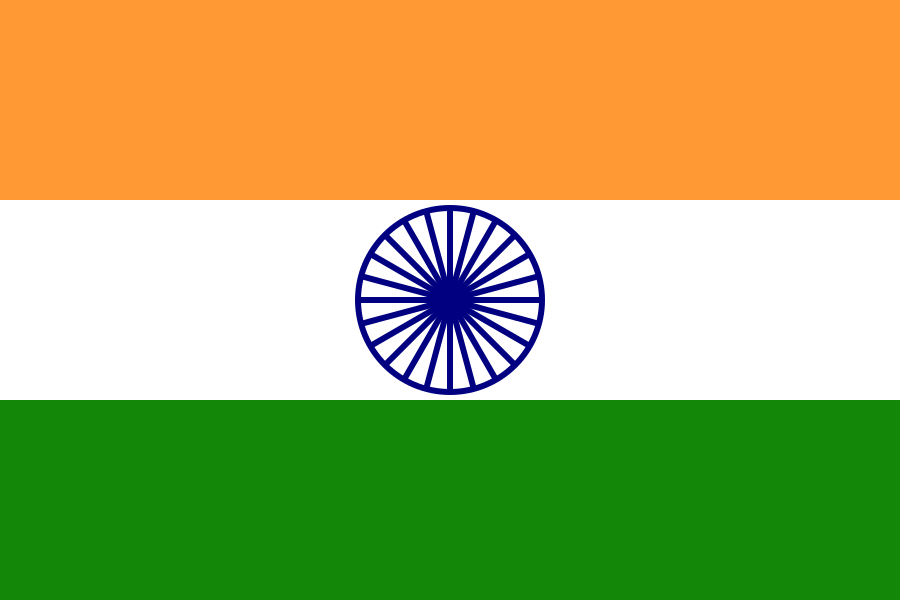
India is among the most diverse countries on earth: Census 2011 records about 1.21 billion people (second largest, soon largest), roughly 1,632 languages and dialects, of which 22 are placed in the 8th Schedule. Religiously, Hindus are about 80% (themselves plural and caste-divided), Muslims 14.2%, Christians 2.3%, Sikhs 1.7%, Buddhists 0.7%, Jains 0.4%. India fits neither the assimilationist nor the integrationist model — it is constitutionally secular yet does not banish religion or language from the public sphere.
- Census 2011: ~1.21 billion people; ~1,632 languages and dialects
- 22 languages in the 8th Schedule, guaranteeing their legal status
- Religion shares: Hindu ~80, Muslim 14.2, Christian 2.3, Sikh 1.7, Buddhist 0.7, Jain 0.4 (%)
- India ruled out assimilation from the start; secular but not identity-banishing — closest to a state-nation
Key terms
- Cultural diversity
- The presence of many communities defined by cultural markers (language, religion, sect, race, caste) within one society or nation.
- Ascriptive identity
- Identity determined by birth and 'belonging', involving no choice and very hard to shed.
- Community identity
- Sense of self anchored in birth-based, overlapping circles — family, kin, caste, language, region, religion.
- Nation
- A 'community of communities' whose members aspire to share one political collectivity (a state).
- State (Weber)
- A body that successfully claims a monopoly of legitimate force over a particular territory and its people.
- Nation-state
- A nation that has acquired a state of its own; the modern one-nation-one-state form of political legitimacy.
- State-nation
- A single state in which many ethnic/religious/linguistic 'nations' co-exist with multiple, complementary identities.
- Assimilation
- Policy forcing all citizens to adopt the dominant group's cultural values, even in the private sphere.
- Integration
- Policy confining public culture to one national pattern while allowing other cultures only in private.
- 8th Schedule
- Constitutional schedule listing officially recognised languages (currently 22), guaranteeing their legal status.
Must-know facts exam-ready
- Census of India 2011: India's population is about 1.21 billion — the world's second largest, projected to become the largest.
- Indians speak about 1,632 languages and dialects; 22 are listed in the 8th Schedule of the Constitution.
- The 8th Schedule began with 14 languages and now has 22 — the last four (Bodo, Dogri, Maithili, Santhali) were added by the 92nd Amendment Act, 2003.
- Religion (2011): Hindus ~80%, Muslims 14.2%, Christians 2.3%, Sikhs 1.7%, Buddhists 0.7%, Jains 0.4%.
- Max Weber's definition: a state is a 'body that successfully claims a monopoly of legitimate force in a particular territory'.
- Box 6.1 is adapted from the UNDP Human Development Report 2004 (on Culture and Democracy).
- Ascriptive identity is based on birth/belonging, not accomplishment, and involves no choice.
- A nation is a 'community of communities'; the criterion closest to defining it is possession of a state.
- The erstwhile USSR officially recognised 100+ internal nationalities — proof that one state can hold many nations.
- 'Secular' was added to the Preamble by the 42nd Amendment Act, 1976, yet India keeps religion within the public sphere.
- India fits neither the assimilationist nor the integrationist model — it is closest to the 'state-nation'.
- NCERT calls India the world's second largest Muslim country (after Indonesia).
Memory tricks remember it for good
Traps to avoid
- Diversity is NOT inequality: diversity emphasises difference, inequality emphasises hierarchy — UPSC blurs them.
- Assimilation vs Integration: both aim at one national identity; the only difference is integration tolerates diversity in the private sphere, assimilation suppresses it even there.
- Nation, State, Nation-state and State-nation are distinct: a nation is a community, a state is the legal-political apparatus; India aspires to a state-nation, not a homogenising nation-state.
- Ascription vs achievement: community identity is given by birth, not earned by exam or skill — unlike a profession or sports team.
- The 8th Schedule lists 22 languages, but the Union's official languages are Hindi and English — scheduling is not the same as official-language status.
- NCERT's line 'second largest Muslim country after Indonesia and Pakistan' is internally garbled; the established fact is India has one of the world's largest Muslim populations, commonly ranked after Indonesia.
Exam focus
🧠 Prelims angles
- 8th Schedule: the count (22), what it guarantees, and the four languages added by the 92nd Amendment (2003).
- Census 2011 religion data — exact percentages and descending order of communities.
- Definition MCQs: ascriptive identity, assimilation vs integration, nation-state vs state-nation.
- Max Weber's definition of the 'state' (monopoly of legitimate force over a territory).
- Secularism in the Constitution — the Preamble and the 42nd Amendment, 1976.
- Total languages/dialects (~1,632) and India's population rank (Census 2011).
✍️ Mains angles GS-I
- Is cultural diversity a threat or a strength for the Indian nation-state?Argue strength — deploy the state-nation model, secularism and the 8th Schedule as accommodation; show that suppression backfires by intensifying identity.
- Distinguish assimilation and integration, and explain why independent India rejected both.Define both via Box 6.1; contrast with India's accommodative secularism that keeps community identities in the public sphere.
- Cultural identities arouse intense passions — examine in the context of communalism, regionalism and resource conflicts.Link ascriptive identity plus scarce resources (river waters, jobs, funds) to real fault-lines; propose state-nation, unity-in-diversity responses.
Last-minute revision tick as you recall
- Diversity = difference, not inequality; danger when it overlaps with inequality + scarce resources.
- Community identity is ascriptive — birth-based, universal, unconditional yet inescapable.
- Nation = community of communities; closest defining trait = having a state (nation-state).
- Weber: state = monopoly of legitimate force over a territory.
- Assimilation erases diversity even in private; integration confines it to the private sphere.
- India is neither assimilationist nor integrationist — closest to a state-nation ('unity in diversity').
- Census 2011: ~1.21 billion people; ~1,632 languages; 22 in the 8th Schedule.
- Religion: Hindu 80, Muslim 14.2, Christian 2.3, Sikh 1.7, Buddhist 0.7, Jain 0.4 (%).
- Box 6.1 = UNDP HDR 2004; remember CLOSER = the six homogenising tools.
Distilled from NCERT Class 12 · Indian Society for UPSC. Always cross-check facts with the original NCERT.