Framing the Constitution: The Beginning of a New Era
How India's Constituent Assembly, meeting between 1946 and 1949 amid the violence of Partition, debated clause-by-clause and drafted the world's longest written Constitution to hold a diverse, divided nation together as a democratic republic.
This is a perennial favourite: Prelims repeatedly tests the Objectives Resolution (who moved it and when), the key committees and their chairmen, the Drafting Committee, and the core dates (13 Dec 1946, 26 Nov 1949, 26 Jan 1950). For Mains it anchors GS-II 'historical underpinnings and evolution' of the Constitution, and feeds GS-I themes on post-Independence consolidation, Partition and nation-building. The Nehru–Ambedkar–Patel roles and the 'borrow versus indigenise' debate are ready-made answer material.
Understand the chapter
A Tumultuous Backdrop: Freedom Amid Partition
India became free on 15 August 1947 but was simultaneously partitioned, unleashing one of history's largest forced migrations and horrific communal massacres. The Great Calcutta Killings of August 1946 had already begun a year of rioting across northern and eastern India, and millions of refugees moved across the new borders, many perishing en route. The Constituent Assembly therefore drafted the Constitution under the shadow of 'desolation and destruction', which shaped its stress on unity, a strong centre and minority safeguards.
- Princely states problem: about one-third of the subcontinent's area lay under nawabs and maharajas whose status turned ambiguous when the British left.
- Recent popular upsurges — Quit India (1942), the INA bid, and the 1946 RIN ratings' revolt — were marked by striking Hindu–Muslim unity.
- Congress and the Muslim League had repeatedly failed to reach a settlement for religious reconciliation.
Making of the Constituent Assembly
The Assembly was NOT elected by universal adult franchise. After provincial elections in the winter of 1945–46, the Provincial Legislatures indirectly chose the members under the Cabinet Mission Plan of 1946. The Congress dominated overwhelmingly — 82 per cent of members — because the Muslim League boycotted to press for Pakistan with a separate constitution, and the Socialists initially stayed away believing the body was a British creation.
- Congress was not monolithic: it held socialists, defenders of landlordism, communal sympathisers and assertive secularists.
- Public participation was actively invited; press debate shaped the eventual consensus.
- Linguistic minorities sought mother-tongue protection, religious minorities sought safeguards, and dalits demanded an end to caste oppression and reservation of seats.
The Dominant Voices and Key Architects
The roughly 300-member Assembly was steered by six dominant figures. The Congress trio was Jawaharlal Nehru (who moved the Objectives Resolution and the National Flag resolution), Vallabhbhai Patel (who worked behind the scenes drafting reports and reconciling opposing views) and Rajendra Prasad (President of the Assembly). They were joined by the lawyer-economist B.R. Ambedkar as Chairman of the Drafting Committee, with K.M. Munshi (Gujarat) and Alladi Krishnaswamy Aiyar (Madras).
- Ambedkar, earlier a Congress opponent, joined the Union Cabinet as Law Minister on Mahatma Gandhi's advice.
- Two civil servants assisted: B.N. Rau (Constitutional Advisor, who studied other countries' systems) and S.N. Mukherjee (Chief Draughtsman, who turned proposals into clear legal language).
- Committee chairs to remember: Drafting — Ambedkar; Flag & Fundamental Rights Sub-Committee — J.B. Kripalani; Minorities Sub-Committee — H.C. Mookerjee.
The Objectives Resolution and the Vision
On 13 December 1946 Nehru moved the Objectives Resolution, the momentous statement that outlined the Constitution's defining ideals and the framework within which constitution-making would proceed. It proclaimed India to be an 'Independent Sovereign Republic', guaranteed justice, equality and freedom to citizens, and assured adequate safeguards for minorities, backward and tribal areas, and the Depressed and Other Backward Classes. Its ideals later became the bedrock of the Preamble.
- Nehru deliberately omitted the word 'democratic', arguing that 'republic' already contained it and that redundant words were unnecessary.
- He signalled a personal and national commitment to socialism and 'economic democracy'.
'We Are Not Going Just to Copy': Borrowing and Indigenising
Nehru located India's effort within a long global history of struggle for liberty, invoking the American and French Revolutions (recalling the Oath of the Tennis Court in Paris) and the more recent Russian Revolution. Yet he insisted the Constitution could not be mechanically borrowed: it had to 'fit in with the temper of our people and be acceptable to them'. The stated objective was to fuse the liberal idea of democracy with the socialist idea of economic justice, reworking these ideas for Indian conditions.
- Selective learning, not copying — India would learn from the West's achievements and failures, and the West too had to learn from experiments elsewhere.
- The form of democracy was left to be decided through deliberation, not predefined.
Process and Output
The Constitution was framed between December 1946 and November 1949, with drafts discussed clause by clause. The Assembly held eleven sessions spread over 165 days, and guiding the Draft through took about three years, the debates filling eleven bulky printed volumes — the Constituent Assembly Debates (CAD). Signed in December 1949, it came into effect on 26 January 1950 and is the longest written Constitution in the world.
- Adopted on 26 November 1949 — now observed as Constitution Day (Samvidhan Divas).
- 26 January was chosen for commencement to honour the 1930 Purna Swaraj (Independence) declaration.
Key terms
- Constituent Assembly
- The body that framed India's Constitution, indirectly elected by the Provincial Legislatures rather than by direct popular vote.
- Objectives Resolution
- Nehru's resolution of 13 December 1946 laying down the guiding ideals of the Constitution; the basis of the Preamble.
- Cabinet Mission Plan (1946)
- The British plan under which the Constituent Assembly was constituted via the provincial legislatures.
- Drafting Committee
- The committee chaired by B.R. Ambedkar (including K.M. Munshi and Alladi Krishnaswamy Aiyar) that prepared the draft Constitution.
- Princely States
- Territories (about one-third of the subcontinent) ruled by nawabs and maharajas whose constitutional status became ambiguous at Independence.
- Great Calcutta Killings
- The communal riots of August 1946 that began a year of almost continuous rioting in northern and eastern India.
- RIN Ratings' Revolt
- The 1946 mutiny of Royal Indian Navy ratings in Bombay and other cities, notable for Hindu–Muslim unity.
- Universal franchise
- The right of all adults to vote — significantly, this was NOT how the Constituent Assembly was elected.
- Constituent Assembly Debates (CAD)
- The eleven-volume printed record of the Assembly's clause-by-clause discussions.
Must-know facts exam-ready
- The Constitution came into effect on 26 January 1950 and is the longest written Constitution in the world.
- It was framed between December 1946 and November 1949; the Assembly held eleven sessions over 165 days.
- The Objectives Resolution was moved by Jawaharlal Nehru on 13 December 1946.
- Members were indirectly elected by the Provincial Legislatures (Cabinet Mission Plan, 1946) after the 1945–46 provincial elections — not by universal franchise.
- Congress made up 82 per cent of the Assembly; the Muslim League boycotted it and the Socialists initially stayed away.
- B.R. Ambedkar was Chairman of the Drafting Committee and Union Law Minister (joining the Cabinet on Gandhi's advice).
- Rajendra Prasad was President of the Constituent Assembly; the chapter notes about 300 members.
- Two key civil servants: B.N. Rau (Constitutional Advisor) and S.N. Mukherjee (Chief Draughtsman).
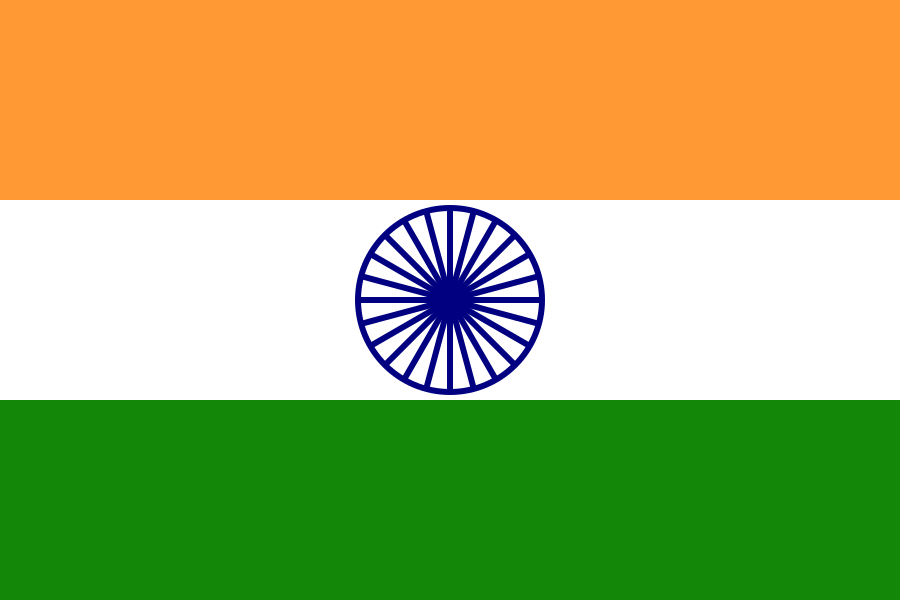
- Nehru's Flag resolution: a horizontal tricolour of saffron, white and dark green in equal proportion, with a wheel in navy blue at the centre.
- Committee chairs: Flag Committee and Fundamental Rights Sub-Committee — J.B. Kripalani; Minorities Sub-Committee — H.C. Mookerjee.
- The Constitution was adopted on 26 November 1949 (now Constitution Day); 26 January honours the 1930 Purna Swaraj declaration.
- Vision of the Constitution: fuse liberal democracy with the socialist idea of economic justice — 'We are not going just to copy.'
Timeline
- 1942Quit India struggle, perhaps the most widespread popular movement against the British Raj.
- 1945-46Provincial elections held; Provincial Legislatures then choose the Constituent Assembly's members.
- Spring 1946Royal Indian Navy ratings' revolt in Bombay and other cities, marked by Hindu–Muslim unity.
- Aug 1946Great Calcutta Killings begin a year of almost continuous communal rioting.
- 13 Dec 1946Nehru moves the Objectives Resolution in the Constituent Assembly.
- 15 Aug 1947Independence with Partition; Nehru's midnight 'tryst with destiny' speech.
- 26 Nov 1949Constitution adopted/signed after three years of debate (now Constitution Day).
- 26 Jan 1950Constitution comes into effect; India becomes a Republic.
Memory tricks remember it for good
Traps to avoid
- Universal-franchise myth: the Assembly was INDIRECTLY elected by Provincial Legislatures, not by universal adult franchise.
- Ambedkar was Chairman of the Drafting Committee, NOT President of the Assembly (that was Rajendra Prasad); he was also a former Congress opponent who joined the Cabinet on Gandhi's advice.
- The Objectives Resolution did NOT use the word 'democratic' — Nehru held that 'republic' already implied it; don't assume the word appears.
- Keep the three dates apart: Objectives Resolution = 13 Dec 1946; adopted = 26 Nov 1949; commenced = 26 Jan 1950.
- 'We are not going just to copy' did not mean rejecting all borrowing — India borrowed ideas but adapted them to its own temper.
- Congress's 82 per cent dominance owed much to the League's boycott and the Socialists staying away, not to others being barred.
Exam focus
🧠 Prelims angles
- Match committees to chairmen: Drafting–Ambedkar, Flag & Fundamental Rights Sub-Committee–Kripalani, Minorities Sub-Committee–Mookerjee, Steering/Rules of Procedure–Rajendra Prasad.
- Objectives Resolution: who moved it, the date (13 Dec 1946), its contents, and its link to the Preamble.
- Constituent Assembly facts: indirect election, Cabinet Mission Plan (1946), 82% Congress, Muslim League boycott.
- Key dates triad: 13 Dec 1946, 26 Nov 1949 (adoption), 26 Jan 1950 (commencement).
- National Flag resolution wording (saffron–white–dark green; navy-blue wheel) and that Nehru moved it.
- Personalities: B.N. Rau (Constitutional Advisor) versus S.N. Mukherjee (Chief Draughtsman); named Drafting Committee members.
✍️ Mains angles GS-II
- The Indian Constitution was framed amid the violence of Partition — how did this context shape its choices?Link desolation, refugees, princely-state integration and communal riots to the stress on unity, a strong centre, minority safeguards and secularism.
- 'We are not going just to copy' — assess the originality of the Indian Constitution.Show selective borrowing from American/French/Russian ideals fused with indigenous adaptation and the goal of economic justice.
- Evaluate the representativeness of the Constituent Assembly given its indirect election and Congress dominance.Balance the 82%/League-boycott critique against Congress's internal diversity and the active public participation invited.
- Discuss the distinct contributions of Ambedkar, Nehru and Patel to constitution-making.Drafting Committee chairmanship; the Objectives Resolution and vision; behind-the-scenes reconciliation and integration of states.
Last-minute revision tick as you recall
- Constitution effective 26 Jan 1950; world's longest; framed Dec 1946–Nov 1949.
- Eleven sessions, 165 days, ~three years, eleven CAD volumes.
- Indirectly elected via Provincial Legislatures (Cabinet Mission, 1946); not universal franchise; 82% Congress.
- Objectives Resolution: Nehru, 13 Dec 1946 — 'Independent Sovereign Republic' + justice/equality/freedom + safeguards — basis of Preamble.
- Six voices: Nehru, Patel, Prasad (Congress) + Ambedkar, Munshi, Alladi (law).
- Ambedkar = Drafting Committee Chair & Law Minister (on Gandhi's advice); Prasad = Assembly President.
- Civil servants: B.N. Rau (Advisor) & S.N. Mukherjee (Chief Draughtsman).
- League boycotted; Socialists initially stayed away; drafted under Partition's shadow.
- Vision: fuse liberal democracy with socialist economic justice — 'We are not going just to copy.'
Distilled from NCERT Class 12 · Themes in Indian History - Part III for UPSC. Always cross-check facts with the original NCERT.