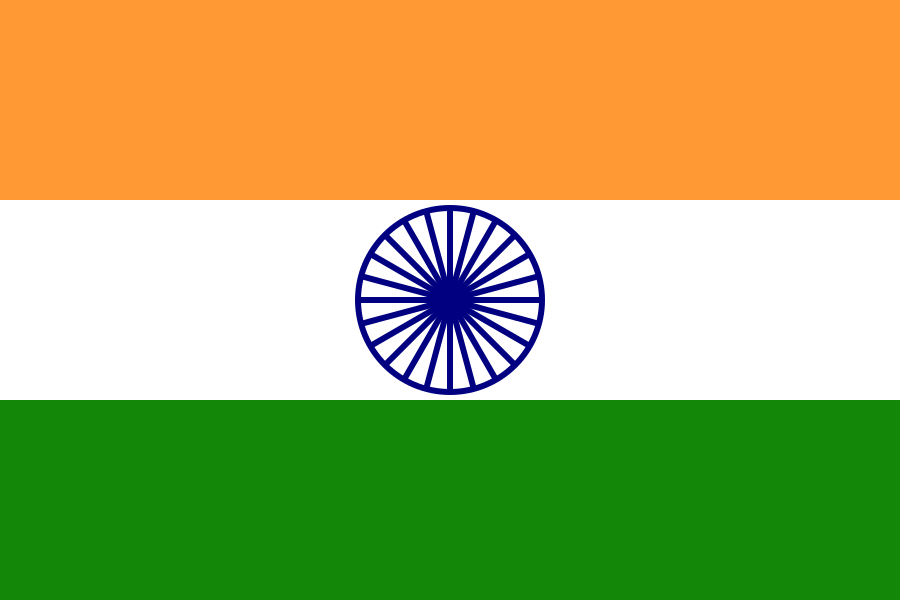
Federalism
Federalism is the constitutional sharing of power between the Union and the states that lets a diverse India stay united while governing itself through multiple tiers.
Federalism is the bedrock of Indian polity and a perennial favourite: Prelims tests the three Lists/Seventh Schedule, residuary powers, coming-together versus holding-together types, Article 1 'Union of States' and special-status states (Article 371). In GS-II it anchors questions on the nature of Indian federalism (federal versus quasi-federal/unitary bias), centre-state relations, devolution and cooperative/competitive federalism. The language and linguistic-states debate also feeds GS-I society and diversity themes.
Understand the chapter
What Federalism Is - and Isn't
Federalism is a system in which power is divided between a central authority and constituent units, with each level drawing its powers independently and being separately answerable to the people. Its dual objective is to safeguard national unity while accommodating regional diversity, which demands both mutual trust and an agreement to live together. It contrasts with a unitary system, where the only or lower tier is subordinate and can be overruled by the centre.
- Two or more tiers govern the same citizens, each with its own jurisdiction over legislation, taxation and administration.
- Each tier's powers are specified and guaranteed by the Constitution and cannot be unilaterally changed by one level.
- The highest court acts as umpire in centre-state disputes; each tier has assured revenue sources for financial autonomy.
- Federal is not unitary: in a unitary system the centre can order the lower tier; in a federation it cannot.
Two Routes: Coming-Together versus Holding-Together
The balance of power between centre and states depends on how the federation was formed. In 'coming-together' federations, independent states pool sovereignty to gain security while retaining identity, so constituent states are equal and strong versus the centre. In 'holding-together' federations, a large country devolves power downward, so the centre stays stronger and units often have unequal powers.
- Coming-together: USA, Switzerland, Australia - equal, strong states.
- Holding-together: India, Spain, Belgium - stronger centre, some units get special powers.
- Belgium shifted from unitary to federal in 1993; Sri Lanka remains effectively unitary.
What Makes India Federal - Constitutional Design
The Constitution declares India a 'Union of States' (Article 1) and, though it never uses the word 'federation', it embodies federal principles. It originally created a two-tier polity (Union and States), to which a third tier of Panchayats and Municipalities was later added. Legislative power is split three ways through the Seventh Schedule, with residuary subjects reserved to the Union.
- Union List (defence, foreign affairs, banking, communications, currency) - only the Union legislates.
- State List (police, trade, commerce, agriculture, irrigation) - only the States legislate.
- Concurrent List (education, forest, trade unions, marriage, adoption, succession) - both legislate, but the Union law prevails on conflict.
- Rigidity and umpire: power-sharing changes need two-thirds of both Houses plus ratification by at least half the states; SC/HC settle disputes.
Asymmetry: Special-Status States and Union Territories
As a 'holding-together' federation, India does not give all units identical powers. Some states enjoy special status under Article 371 to protect indigenous land, culture and government jobs, while Union Territories sit at the other extreme with the Centre exercising special control. This deliberate asymmetry accommodates peculiar social and historical circumstances.
- Article 371 special powers: Assam, Nagaland, Arunachal Pradesh, Mizoram - outsiders cannot buy land or house there.
- Union Territories: Delhi, Chandigarh, Lakshadweep - too small for statehood, run by the Centre.
- Asymmetry is a feature, not a flaw, of holding-together federations.
Federalism in Practice I: Linguistic States
Constitutional text alone did not make federalism succeed; democratic politics did. The creation of linguistic states was its first major test: from 1947 boundaries were redrawn so same-language speakers shared a state, though some states were formed on culture, ethnicity or geography. Feared as a recipe for disintegration, linguistic reorganisation instead made India more united and administration easier.
- First linguistic state: Andhra (1953); the States Reorganisation Act, 1956 redrew the map.
- Language-based states versus culture/ethnicity/geography-based states (Nagaland, Uttarakhand, Jharkhand).
- Outcome: stronger unity, not break-up.
Federalism in Practice II: Language Policy
The Constitution gave no language 'national' status; Hindi was made the official language, but as the mother tongue of only about 40 per cent of Indians it came with safeguards. Besides Hindi, 21 other languages are recognised as Scheduled Languages, and central exams may be taken in any of them. India's flexible, cautious approach - continuing English past the 1965 deadline after Tamil Nadu's protests - helped it avoid Sri Lanka's fate.
- Official language Hindi is NOT the national language; India has no national language.
- Eighth Schedule: 22 scheduled languages (Hindi plus 21 others).
- English continued alongside Hindi after 1965; Hindi is promoted but never imposed.
Federalism in Practice III: Centre-State Relations
How power-sharing actually works depends on the ruling parties. When one party ruled both the Centre and most states, state governments rarely asserted autonomy, and the Centre often misused constitutional provisions to dismiss rival-party state governments, hurting the federal spirit. This changed sharply after 1990 with the rise of regional parties and coalition politics, which strengthened federalism in practice.
- Pre-1990: single-party dominance and dismissal of opposition state governments.
- Post-1990: regional parties and coalitions deepen real federalism.
- Lesson: federalism lives in political practice, not just in the text.
Key terms
- Federalism
- A system dividing power between a central authority and constituent units, each with independent, constitutionally guaranteed powers.
- Unitary system
- A system with only one level of government, or where sub-units are subordinate to and can be overruled by the centre.
- Jurisdiction
- The area - geographical or by subject - over which a government has legal authority.
- Coming-together federation
- Independent states pool sovereignty to form a larger unit; states are equal and strong (USA, Switzerland, Australia).
- Holding-together federation
- A large country divides power between centre and states; the centre is stronger and units may be unequal (India, Spain, Belgium).
- Concurrent List
- Subjects (education, forest, marriage) on which both Union and States legislate; the Union law prevails on conflict.
- Residuary subjects
- Matters not in any of the three lists (e.g., new subjects like computer software) on which the Union alone legislates.
- Union of States
- The Constitution's description of India (Article 1) signifying federalism without using the word 'federation'.
- Union Territory
- A small area, neither a full state nor mergeable, administered with special powers by the Centre (Delhi, Chandigarh, Lakshadweep).
- Scheduled Languages
- Languages in the Eighth Schedule (Hindi plus 21 others = 22) usable in Central Government examinations.
Must-know facts exam-ready
- Only 25 of the world's 193 countries are federal, yet they hold about 40 per cent of the world's population.
- India is a 'Union of States' (Article 1); the Constitution never uses the word 'federation'.
- Two routes: coming-together (USA, Switzerland, Australia - strong states) versus holding-together (India, Spain, Belgium - strong centre).
- Three Lists (Seventh Schedule): Union, State, Concurrent; on a Concurrent conflict the Union law prevails; residuary powers lie with the Union.
- Union List: defence, foreign affairs, banking, communications, currency. State List: police, trade, commerce, agriculture, irrigation. Concurrent: education, forest, trade unions, marriage, adoption, succession.
- Special status to Assam, Nagaland, Arunachal Pradesh and Mizoram under Article 371 (land, culture, government jobs).
- Union Territories (Delhi, Chandigarh, Lakshadweep) are administered by the Centre and have fewer powers than states.
- Federal amendment: two-thirds majority in both Houses plus ratification by the legislatures of at least half the states.
- Hindi is the official language (not national); India has no national language; Hindi is the mother tongue of about 40 per cent of Indians.
- Eighth Schedule has 22 scheduled languages (Hindi plus 21); English's official use was to end in 1965 but was continued after Tamil Nadu's protests.
- The third tier (Panchayats and Municipalities) was added later by the 73rd and 74th Constitutional Amendment Acts, 1992.
- Linguistic reorganisation: first linguistic state Andhra (1953); States Reorganisation Act, 1956; post-1990 regional parties strengthened federalism in practice.
Timeline
- 1947India becomes independent; princely states integrate and old state boundaries begin to be redrawn.
- 1953Andhra becomes the first state created on a linguistic basis.
- 1956States Reorganisation Act reorganises states largely on linguistic lines.
- 1965Deadline to end English for official purposes; Tamil Nadu protests lead the Centre to continue English with Hindi.
- 1990Rise of regional parties and coalition politics strengthens federalism in practice.
- 199273rd and 74th Constitutional Amendments add the third tier (Panchayats and Municipalities).
- 1993Belgium shifts from a unitary to a federal system by giving regional governments constitutional powers.
Memory tricks remember it for good
Traps to avoid
- India's Constitution never uses the word 'federation' - Article 1 calls it a 'Union of States'; do not assume 'federal' appears in the text.
- Hindi is the official language, NOT the national language; India has no national language, and the Eighth Schedule lists scheduled (not 'national') languages.
- Do not swap the routes: coming-together means strong STATES (USA, Switzerland, Australia); holding-together means strong CENTRE (India, Spain, Belgium).
- On a Concurrent List conflict the UNION law prevails (not the state law), and residuary powers lie with the UNION (not the states).
- Special-status states (Article 371: Assam, Nagaland, Arunachal, Mizoram) have MORE autonomy, whereas Union Territories have LESS - the Centre rules UTs; do not invert.
- Article 371 (special provisions for the named north-eastern states) is different from the former Article 370 (Jammu and Kashmir, abrogated in 2019) - do not conflate them.
Exam focus
🧠 Prelims angles
- Match-the-following on federation types: USA/Switzerland/Australia (coming-together) versus India/Spain/Belgium (holding-together).
- Subject-to-List mapping (Seventh Schedule): police = State, education = Concurrent, defence/banking/currency = Union; residuary = Union.
- Article 1 'Union of States'; the Constitution avoids the word 'federation'; India as a holding-together federation.
- Language facts: Hindi official (not national), no national language, Eighth Schedule 22 scheduled languages, English deadline 1965.
- Article 371 special-status states (Assam, Nagaland, Arunachal, Mizoram) and UT examples (Delhi, Chandigarh, Lakshadweep).
- Linguistic reorganisation: first linguistic state Andhra (1953), States Reorganisation Act 1956; third tier via 73rd and 74th Amendments, 1992.
✍️ Mains angles GS-II
- Is the Indian Constitution federal, or 'federal in form but unitary in spirit' (quasi-federal)?Balance federal features (constitutional division, Seventh Schedule, judicial umpire, rigid amendment) against unitary tilts (residuary and Concurrent-conflict to the Union, strong centre, dismissal of state governments).
- Linguistic reorganisation of states strengthened, rather than weakened, Indian unity. Examine.Rebut the disintegration fear with easier administration and accommodation of diversity; cite the 1956 reorganisation.
- Federalism in India is sustained as much by democratic practice as by constitutional text. Discuss.Contrast post-1990 regional parties and coalitions with pre-1990 misuse of central power to dismiss state governments.
- India's flexible language policy helped it avoid Sri Lanka's ethnic strife. Comment.Contrast official-versus-national language, continuation of English, and non-imposition of Hindi with Sri Lanka's rigidity.
Last-minute revision tick as you recall
- Federalism = power divided between centre and constituent units; two or three tiers, each with constitutionally guaranteed jurisdiction.
- Two routes: coming-together (USA, Switzerland, Australia - strong states) and holding-together (India, Spain, Belgium - strong centre).
- India = 'Union of States' (Article 1); the word 'federation' is never used; it is a holding-together type.
- Three Lists (Seventh Schedule): Union, State, Concurrent; Concurrent conflict goes to the Union; residuary goes to the Union.
- Special status: Assam, Nagaland, Arunachal, Mizoram under Article 371; UTs (Delhi, Chandigarh, Lakshadweep) are run by the Centre.
- Federal amendment: two-thirds of both Houses plus ratification by at least half the states; SC/HC act as umpire.
- Practised through linguistic states, language policy and centre-state relations (deepened by post-1990 regional parties).
- Hindi is official (not national); no national language; 22 scheduled languages (Eighth Schedule); English continued past 1965; third tier added by the 73rd and 74th Amendments, 1992.
Distilled from NCERT Class 10 · Democratic Politics II for UPSC. Always cross-check facts with the original NCERT.