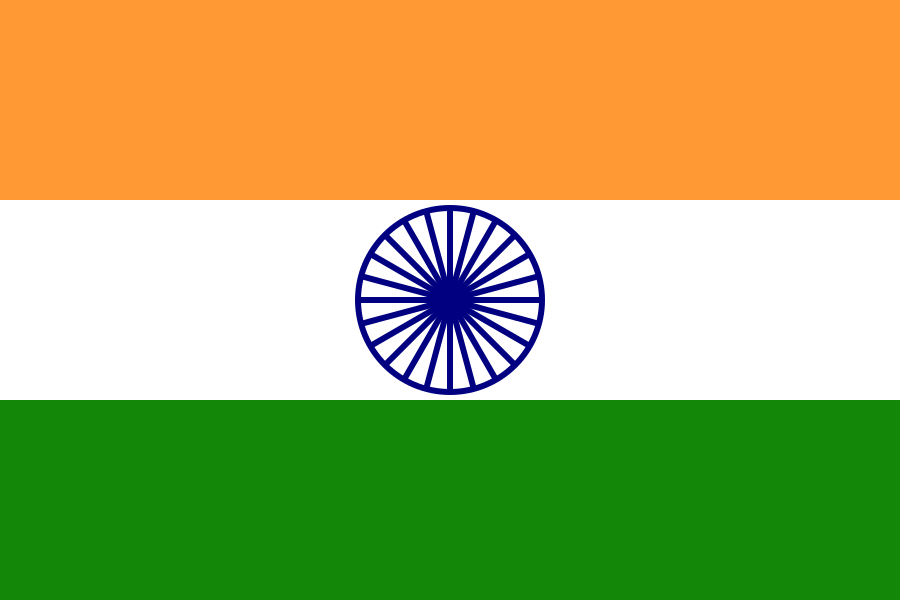
Nationalism in India
How the anti-colonial struggle of the 1920s — Satyagraha, the Rowlatt agitation, Khilafat and Non-Cooperation — forged a shared Indian national identity across deeply diverse social groups.
This is core Modern Indian History — the foundation of the Gandhian mass phase of the freedom struggle, perennially tested in Prelims through satyagrahas, repressive Acts, Congress sessions, statistics and personalities. For Mains GS-I it feeds the 'various stages of the freedom struggle and important contributors' theme and the analysis of Gandhi's method of mass mobilisation. Prelims especially loves matching movements to places/leaders (Champaran, Kheda, Bardoli, Awadh, Gudem) and pinning the exact April 1919 dates.
Understand the chapter
Why Modern Nationalism Grew in India
Indian nationalism was forged in the crucible of anti-colonialism — the shared sense of being oppressed tied diverse groups together, even though each class felt colonialism differently and imagined 'freedom' in its own way. The First World War transformed the situation: soaring defence spending was financed by war loans, higher customs duties and a new income tax, while prices doubled between 1913 and 1918. Forced recruitment, crop failures (1918–19 and 1920–21) and an influenza epidemic killed an estimated 12–13 million people per the 1921 Census. Post-war hopes of relief were dashed, creating fertile ground for a mass movement that Congress under Gandhi tried to unify.
- Nationalism = a new shared identity built through the struggle against colonial rule.
- WWI fallout: war loans, raised customs duties, a new income tax, prices doubled 1913–18.
- 1918–21: famines + influenza killed ~12–13 million (1921 Census).
- Unity was real but came 'with conflict' — groups had different notions of freedom.
Satyagraha: The Power of Truth and Non-Violence
Gandhi returned from South Africa in January 1915 with satyagraha — a novel method of mass agitation resting on truth (satya) and non-violence (ahimsa). It held that a just cause needs no physical force; the satyagrahi appeals to the oppressor's conscience so that truth ultimately triumphs. Gandhi insisted this was active, not passive, resistance — 'pure soul-force', never the weapon of the weak. He proved the method in three early local satyagrahas before launching anything national.
- Champaran (1917, Bihar): first satyagraha in India — against the oppressive indigo plantation system.
- Ahmedabad (1918): satyagraha among cotton mill workers.
- Kheda (1918, Gujarat): peasants hit by crop failure and plague sought revenue relief.
- Non-violence framed as the supreme dharma capable of uniting all Indians.
Rowlatt Act and the Jallianwala Bagh Massacre
In 1919 Gandhi launched a nationwide satyagraha against the Rowlatt Act, rushed through the Imperial Legislative Council despite united Indian opposition; it allowed detention of political prisoners without trial for two years. A hartal began on 6 April 1919. After repression in Amritsar, on 13 April General Dyer blocked the exits and opened fire on a crowd gathered at the enclosed Jallianwala Bagh on Baisakhi day, killing hundreds to 'produce a moral effect' of terror. As violence spread and the state unleashed humiliating repression (crawling orders, floggings), Gandhi called off the movement.
- Rowlatt Act = Anarchical and Revolutionary Crimes Act, 1919; detention without trial up to 2 years.
- Hartal began 6 April 1919; Gandhi barred from Delhi, Amritsar leaders arrested.
- Jallianwala Bagh: 13 April 1919, Baisakhi, Amritsar; Gen. Reginald Dyer.
- Gandhi withdrew once violence spread — a recurring Gandhian pattern.
Khilafat and the Logic of Non-Cooperation
To build a broad-based, Hindu–Muslim movement, Gandhi took up the Khilafat cause — defending the temporal powers of the Ottoman Khalifa after Turkey's defeat in WWI. A Khilafat Committee formed in Bombay (March 1919), and the Ali brothers (Muhammad Ali and Shaukat Ali) allied with Gandhi. His reasoning, drawn from Hind Swaraj (1909), was that British rule survived only on Indian cooperation — withdraw it and swaraj would come within a year. The programme was to unfold in stages, escalating to full civil disobedience if met with repression.
- Stages: surrender titles → boycott schools, courts, councils, civil services, army, police, foreign goods → civil disobedience.
- Calcutta session (Sept 1920): non-cooperation resolution accepted.
- Nagpur session (Dec 1920): Non-Cooperation programme formally adopted.
- Khilafat fused a pan-Islamic cause with swaraj to cement Hindu–Muslim unity.
Differing Strands I: The Movement in the Towns
The Non-Cooperation–Khilafat Movement began in January 1921 with middle-class urban participation — students left government schools, headmasters, teachers and lawyers resigned, and council elections were boycotted everywhere except Madras. There the Justice Party (the non-Brahman party) saw the council as a route to power usually monopolised by Brahmans. The economic boycott bit hardest: foreign cloth was burnt, liquor shops picketed, and imports of foreign cloth halved from Rs 102 crore to Rs 57 crore (1921–22). But it slowed because khadi was costlier than mill cloth and alternative Indian institutions were slow to emerge.
- Council elections boycotted except Madras — Justice Party of non-Brahmans contested.
- Foreign cloth imports halved: Rs 102 crore → Rs 57 crore (1921–22).
- Slowdown: khadi dearer than mill cloth; Indian schools/courts came up slowly.
- 'Swaraj' meant different things to different groups — a unifying yet ambiguous slogan.
Differing Strands II: Peasants and Tribals
In the countryside, swaraj acquired radical local meanings the Congress could not always control. In Awadh, Baba Ramchandra — a sanyasi and former indentured labourer in Fiji — led peasants against talukdars' exorbitant rents, begar and insecure tenure; the Oudh Kisan Sabha was set up (Oct 1920) with Jawaharlal Nehru. In the Gudem Hills of Andhra Pradesh, tribals under Alluri Sitaram Raju waged a militant guerrilla revolt against forest restrictions and forced begar — non-violence ignored. The later Bardoli Satyagraha (1928, Gujarat) under Vallabhbhai Patel against a revenue hike showed disciplined peasant mobilisation.
- Awadh demands: revenue cut, abolition of begar, social boycott of oppressive landlords; nai–dhobi bandhs.
- Oudh Kisan Sabha (Oct 1920): Nehru and Baba Ramchandra; 300+ village branches.
- Gudem Hills tribals: Alluri Sitaram Raju; militant guerrilla method (not Gandhian).
- Bardoli Satyagraha (1928): Vallabhbhai Patel vs land-revenue enhancement.
Key terms
- Satyagraha
- Mass agitation based on truth and non-violence, appealing to the oppressor's conscience — active 'soul-force', not passive resistance.
- Swaraj
- Self-rule — the movement's unifying goal, but understood differently by towns, peasants and tribals.
- Khilafat Movement
- Indian Muslim agitation to defend the Ottoman Khalifa's powers, joined with Non-Cooperation for Hindu–Muslim unity.
- Non-Cooperation
- Withdrawing Indian cooperation (boycott of titles, schools, courts, councils, foreign goods) to make British rule collapse.
- Begar
- Forced, unpaid labour that villagers had to contribute to landlords or the state.
- Boycott
- Refusal to deal with, participate in, or buy/use certain things or institutions as a form of protest.
- Picket
- Protest that blocks the entrance to a shop, factory or office.
- Forced recruitment
- The colonial state compelling rural men to join the army.
- Hartal
- A mass strike with closure of shops and work as a mode of protest.
- Khadi
- Hand-spun, hand-woven Indian cloth — symbol of self-reliance, but often costlier than mill cloth.
Must-know facts exam-ready
- Gandhi returned to India from South Africa in January 1915 (9 January; commemorated as Pravasi Bharatiya Divas).
- Champaran (1917, Bihar) was Gandhi's first satyagraha in India — against the indigo plantation system.
- Rowlatt Act (1919) = Anarchical and Revolutionary Crimes Act; allowed detention without trial for two years; passed by the Imperial Legislative Council.
- Rowlatt hartal began on 6 April 1919.
- Jallianwala Bagh massacre: 13 April 1919, Baisakhi day, Amritsar; ordered by General Reginald Dyer.
- Khilafat Committee formed in Bombay in March 1919; led by Muhammad Ali and Shaukat Ali (the Ali brothers).
- Non-Cooperation accepted at the Calcutta session (Sept 1920) and formally adopted at the Nagpur session (Dec 1920).
- Hind Swaraj (1909) argued British rule survived only on Indian cooperation.
- Foreign cloth imports halved from Rs 102 crore to Rs 57 crore between 1921 and 1922.
- Oudh Kisan Sabha set up October 1920 (Jawaharlal Nehru, Baba Ramchandra); 300+ branches within a month.
- Bardoli Satyagraha (1928) led by Vallabhbhai Patel against land-revenue enhancement in Gujarat.
- 1921 Census: ~12–13 million died from famines and the influenza epidemic (1918–21).
Timeline
- 1909Gandhi publishes Hind Swaraj, arguing British rule rests on Indian cooperation.
- 1915Gandhi returns to India from South Africa (January).
- 1917Champaran satyagraha — against the indigo plantation system (Bihar).
- 1918Ahmedabad mill-workers' and Kheda peasants' satyagrahas (Gujarat).
- 1919Khilafat Committee (March); Rowlatt Act and hartal (6 April); Jallianwala Bagh (13 April).
- 1920Calcutta (Sept) and Nagpur (Dec) sessions adopt Non-Cooperation; Oudh Kisan Sabha (Oct).
- 1921Non-Cooperation–Khilafat Movement begins (January).
- 1928Bardoli Satyagraha under Vallabhbhai Patel.
Memory tricks remember it for good
Traps to avoid
- Rowlatt hartal was 6 April 1919; Jallianwala Bagh was 13 April 1919 — don't merge the two dates or place the firing on the hartal day.
- Champaran/Ahmedabad/Kheda (1917–18) are early LOCAL satyagrahas before Non-Cooperation; Bardoli (1928) is LATER and led by Patel, not Gandhi.
- Non-Cooperation was ACCEPTED at Calcutta (Sept 1920) but formally ADOPTED at Nagpur (Dec 1920) — two different sessions, often swapped.
- Khilafat defended the Ottoman Khalifa's temporal powers after WWI and is paired with NON-COOPERATION (not Civil Disobedience).
- The Justice Party (non-Brahmans) CONTESTED the Madras council — it did not boycott; Madras is the exception to the election boycott.
- Alluri Sitaram Raju's Gudem revolt was MILITANT/guerrilla — not Gandhian non-violence; the Congress did not approve such methods.
Exam focus
🧠 Prelims angles
- Match satyagraha to place/issue: Champaran–indigo, Kheda–revenue, Ahmedabad–mill workers, Bardoli–revenue hike.
- Exact dates: Gandhi's return (Jan 1915), Rowlatt hartal (6 Apr 1919), Jallianwala Bagh (13 Apr 1919), Nagpur session (Dec 1920).
- Rowlatt Act identity (Anarchical and Revolutionary Crimes Act, 1919) and its 'detention without trial' provision.
- Person-to-movement matching: Baba Ramchandra–Awadh, Alluri Sitaram Raju–Gudem, Ali brothers–Khilafat, Patel–Bardoli.
- Statistics often quoted: foreign cloth imports Rs 102 → 57 crore (1921–22); ~12–13 million deaths (1921 Census).
- Justice Party = party of non-Brahmans in Madras that contested rather than boycotted.
✍️ Mains angles GS-I
- Why did 'Swaraj' mean different things to different social groups, and how did this challenge Congress unity in the early 1920s?Contrast town middle-class (boycott, education) vs Awadh peasants (anti-talukdar, no-rent) vs Gudem tribals (forest rights, violence); show swaraj as an elastic, contested idea.
- Assess satyagraha as a method of mass mobilisation in the Gandhian phase of the freedom struggle.Define satya/ahimsa as active soul-force; trace Champaran → Rowlatt → Non-Cooperation; note Gandhi's withdrawals when violence erupted.
- How did the Khilafat issue shape Hindu–Muslim unity within the national movement?Explain the Khilafat logic, Bombay Committee and Ali brothers, and the Calcutta–Nagpur fusion with swaraj; hint at the fragility of the alliance.
Last-minute revision tick as you recall
- Nationalism = unity forged through anti-colonial struggle; WWI hardship set the stage.
- Satyagraha = active soul-force (truth + non-violence); proven at Champaran, Ahmedabad, Kheda (1917–18).
- Rowlatt Act 1919 → hartal 6 April → Jallianwala Bagh 13 April (Dyer, Baisakhi).
- Khilafat (Bombay, Mar 1919; Ali brothers) + swaraj → Non-Cooperation.
- Hind Swaraj (1909): British rule lives on Indian cooperation — so withdraw it.
- Sessions: Calcutta (Sept 1920) accepts, Nagpur (Dec 1920) adopts; movement begins Jan 1921.
- Towns: students/lawyers quit, foreign cloth Rs 102→57 cr; Madras Justice Party contested.
- Countryside: Awadh (Baba Ramchandra, Oudh Kisan Sabha), Gudem (Alluri Sitaram Raju), Bardoli (Patel, 1928).
- Swaraj meant different things to different groups — unity, but with conflict.
Distilled from NCERT Class 10 · Contemporary India II for UPSC. Always cross-check facts with the original NCERT.