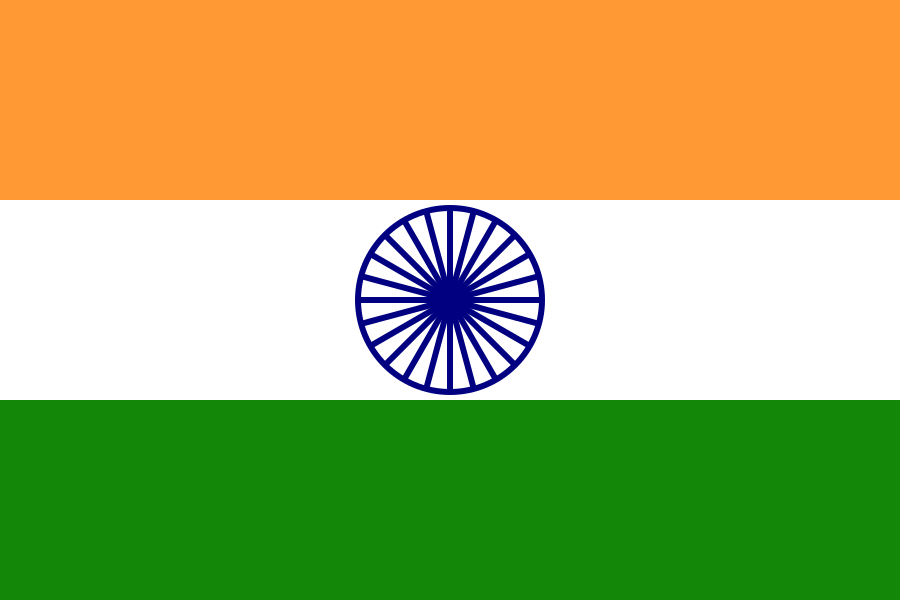
The Indian Constitution
Why a democratic society needs a written Constitution, how India's was framed by the Constituent Assembly, and the key features—Fundamental Rights and secularism—that make it the supreme rulebook of our democracy.
This is the foundational Polity chapter: it seeds high-frequency Prelims facts on the Constituent Assembly (1934 demand, Dec 1946 convening, ~300 members), Fundamental Rights/Right to Equality, and secularism. For Mains it feeds GS-II themes on the Constitution's purposes, safeguards against majoritarianism, and the distinctive Indian model of secularism. Its conceptual vocabulary—constitutive rules, tyranny of the majority, principled distance—recurs across polity and ethics answers.
Understand the chapter
Constitution as the Constitutive Rulebook
A Constitution is a written document containing the fundamental rules—constitutive rules—that define a society and distinguish it from others, just as the no-hands rule defines football and separates it from hockey. In large, diverse societies these rules are arrived at through consensus and, in modern states, recorded in writing. It fixes both the type of government and the shared ideals a country agrees to uphold.
- Constitutive rules: fundamental rules that make a game/society what it is
- Football analogy: handling the ball means it is no longer football
- Democracies likely have a Constitution, but not every country with one is democratic
- Consensus among diverse communities, set down in written form
Three Reasons a Country Needs a Constitution
The chapter gives three core purposes. First, it lays down ideals defining the kind of country we want—Nepal rewrote its Constitution after shifting from monarchy to democracy. Second, it defines the political system and guards against misuse of authority and the tyranny of the majority. Third, it 'saves us from ourselves' by protecting the basic structure from rash, emotion-driven choices such as inviting a dictator.
- Ideals: defines the fundamental nature of society (Nepal example)
- Safeguards: checks misuse of power by leaders; protects minorities
- Self-protection: blocks easy overthrow of rights and basic structure
Making of the Indian Constitution
The demand for a Constituent Assembly of Indians was raised by the Indian National Congress in 1934 and gained momentum during the Second World War. Around 300 members convened in December 1946 and, meeting periodically over three years, drafted the Constitution between December 1946 and November 1949. After roughly 150 years of British rule, members worked with idealism born of the freedom struggle, debating each provision and seeking consensus amid Partition and undecided Princely States.
- 1934: INC demanded a Constituent Assembly
- Convened December 1946; about 300 members
- Drafted Dec 1946 to Nov 1949; Nehru and Patel were prominent members
- Backdrop: Partition, undecided Princely States, diverse communities
Key Features: Fundamental Rights and Right to Equality
The long experience of authoritarian colonial rule convinced Indians that free India must be a democracy of equals. Many safeguards against the misuse of power are placed in the Fundamental Rights. The Right to Equality guarantees that no citizen is discriminated against on grounds of religion, race, caste, gender or place of birth.
- Fundamental Rights = constitutional safeguards against misuse of power
- Right to Equality: a core Fundamental Right
- No discrimination on: religion, race, caste, gender, place of birth
- Static anchor: equality cluster = Articles 14-18; Article 15 = non-discrimination
Tyranny of the Majority and Forms of Domination
Even democracies risk a majority repeatedly enforcing decisions that exclude minorities—the tyranny of the majority, illustrated by boys outvoting girls over the game. The Constitution contains rules to prevent such domination and to ensure minorities get what is routinely available to the majority. The chapter distinguishes inter-community domination (one community over another) from intra-community domination (within the same community).
- Tyranny of the majority: majority overrides minority interests
- Inter-community vs intra-community domination
- Minorities must access what majorities routinely enjoy
Indian Secularism: Separation with Principled Distance
Secularism means separation between Religion and the State, important to prevent inter-religious domination (one religion over another) and intra-religious domination (e.g., 'upper castes' dominating 'lower castes' through untouchability). Indian secularism is unique: it keeps a separation yet also intervenes to reform religion—banning untouchability and child marriage, or assisting minorities. This selective intervention, guided only by Constitutional ideals, is called 'principled distance'.
- Separation prevents inter- and intra-religious domination
- Indian model: separation plus intervention (ban or assistance)
- Principled distance: interference only on Constitutional ideals
- Static anchor: untouchability abolished under Article 17
Key terms
- Constitution
- Written document setting out a country's fundamental (constitutive) rules and ideals.
- Constitutive rules
- Fundamental rules that define a society (or game) and distinguish it from others.
- Constituent Assembly
- The body of around 300 members that drafted India's Constitution (1946-1949).
- Tyranny of the majority
- When a majority continuously enforces decisions that exclude or harm minorities.
- Fundamental Rights
- Constitutionally guaranteed rights that safeguard citizens against misuse of power.
- Secularism
- Separation between Religion and the State.
- Principled distance
- Indian secularism's stance: the State stays separate from religion yet may intervene only on Constitutional ideals.
- Inter-community domination
- One community dominating another.
- Intra-community domination
- Domination of members within the same community.
- Princely States
- Indian states ruled by princes whose accession was undecided at Independence.
Must-know facts exam-ready
- 1934: the Indian National Congress first demanded a Constituent Assembly.
- The Constituent Assembly was convened in December 1946 with about 300 members.
- The Constitution was drafted between December 1946 and November 1949.
- India had been under roughly 150 years of British rule.
- Jawaharlal Nehru and Sardar Vallabhbhai Patel were prominent Constituent Assembly members.
- Right to Equality bars discrimination on religion, race, caste, gender and place of birth.
- Static: equality cluster = Articles 14-18; Article 15 = non-discrimination; Article 17 = abolition of untouchability.
- Static: Constituent Assembly first met 9 December 1946; Constitution adopted 26 November 1949; came into force 26 January 1950.
- Nepal's earlier Constitution (1990) vested final authority in the King.
- Nepal abolished the monarchy and became a democracy in 2008, then adopted a new Constitution in 2015.
- Secularism = separation of Religion and State; Indian secularism = 'principled distance'.
- Static: the word 'secular' was added to the Preamble by the 42nd Amendment, 1976.
Timeline
- 1934Indian National Congress demands a Constituent Assembly.
- December 1946Constituent Assembly convened with about 300 members.
- 1946-1949Assembly drafts the Constitution (completed November 1949).
- 1990Nepal adopts a Constitution making the King the final authority.
- 2006People's movement ends the powers of Nepal's King.
- 2008Nepal abolishes the monarchy and becomes a democracy.
- 2015Nepal adopts a new Constitution.
Memory tricks remember it for good
Traps to avoid
- 'Constitution equals democracy' is wrong: all democracies likely have a Constitution, but not every country with a Constitution is democratic.
- Do not swap inter- (between communities/religions) with intra- (within one)—untouchability is intra-religious domination.
- Indian secularism is NOT total separation: the State both separates from AND intervenes in religion ('principled distance').
- The demand for a Constituent Assembly dates to 1934 (INC), but it was convened only in December 1946—do not merge the two.
- 'Tyranny of the majority' is a danger within democracies too, not only in authoritarian states.
- Nepal dates differ: King's powers ended in 2006, monarchy abolished in 2008, new Constitution in 2015—do not collapse them into one year.
Exam focus
🧠 Prelims angles
- Constituent Assembly: 1934 demand by INC, convened Dec 1946, ~300 members, drafting 1946-1949.
- Right to Equality: grounds of non-discrimination (religion, race, caste, gender, place of birth); Articles 14-18, Art 15, Art 17.
- Secularism: separation of Religion and State, 'principled distance', and the 42nd Amendment (1976) adding 'secular' to the Preamble.
- Frequently paired static facts: Constitution adopted 26 Nov 1949, enforced 26 Jan 1950; Drafting Committee chaired by B.R. Ambedkar.
- Nepal's democratic transition dates (1990, 2006, 2008, 2015) as a comparative-polity hook.
✍️ Mains angles GS-II
- Why does a democracy need a written Constitution?Use the three functions—ideals, safeguards against misuse and tyranny of the majority, and protection of basic structure from rash majorities; cite Nepal.
- How does Indian secularism differ from Western secularism?Contrast strict separation with 'principled distance'; the State intervenes to reform (untouchability, child marriage) and assist minorities, guided by Constitutional ideals.
- How does the Constitution protect minorities from the tyranny of the majority?Fundamental Rights, Right to Equality, inter-/intra-community domination, and ensuring minorities access what majorities routinely enjoy.
Last-minute revision tick as you recall
- Constitution = written constitutive rulebook of ideals plus government type.
- Three needs: Ideals, Safeguards, Save us from ourselves (ISS).
- 1934 INC demand to Dec 1946 Assembly (~300) to 1949 drafted.
- Nehru and Patel: prominent Constituent Assembly members.
- Right to Equality: no bias on religion, race, caste, gender, place of birth.
- Tyranny of majority; inter- vs intra-community domination.
- Secularism = Religion-State separation (stops inter- and intra-religious domination).
- Indian secularism = separation plus intervention = 'principled distance'.
- Nepal: 2006 King's powers end, 2008 monarchy abolished, 2015 new Constitution.
Distilled from NCERT Class 8 · Resources and Development for UPSC. Always cross-check facts with the original NCERT.